I went to a community event that was hosted in a non-Catholic church the other day. There was a quick prayer service, and the preacher gave a full sermon.
It reminded me of the time I had spent attending other churches before returning to my Catholic faith fourteen years ago. That time taught me a lot, and I loved those Sunday morning praise services back then. But now, something was very different.
The preacher was giving a sermon on suffering. It centered around thought-provoking points, and his jokes were engaging and funny.
I really liked all of the people there. They were warm and friendly and comfortable to be around, and they genuinely cared about my family.
But, still, I struggled with a feeling of dissonance as I listened to the preacher.
At the end of the sermon, he made the point about how the Bible says we are not supposed to hold on to rituals or religion—that the goal is a personal relationship with Jesus.
We live in an area of the country where Catholics don’t even show up on some local demographic maps, so I hear this argument quite a bit. People often use it to say that Catholicism is flawed because it is a religion with standard doctrine and practices. The implication is that doctrine and standard practices somehow hinder our relationship with Christ. And, before, I never knew how to respond. But this day, listening to the preacher make that point, I really wanted to talk to him, and I knew what I wanted to say:
“Thank you for inviting us into your church. The music is uplifting, the people in your congregation are warm and welcoming, and the prayers are heartfelt.
But, you see, in the Mass, Jesus comes…and He fills my heart with His own.”
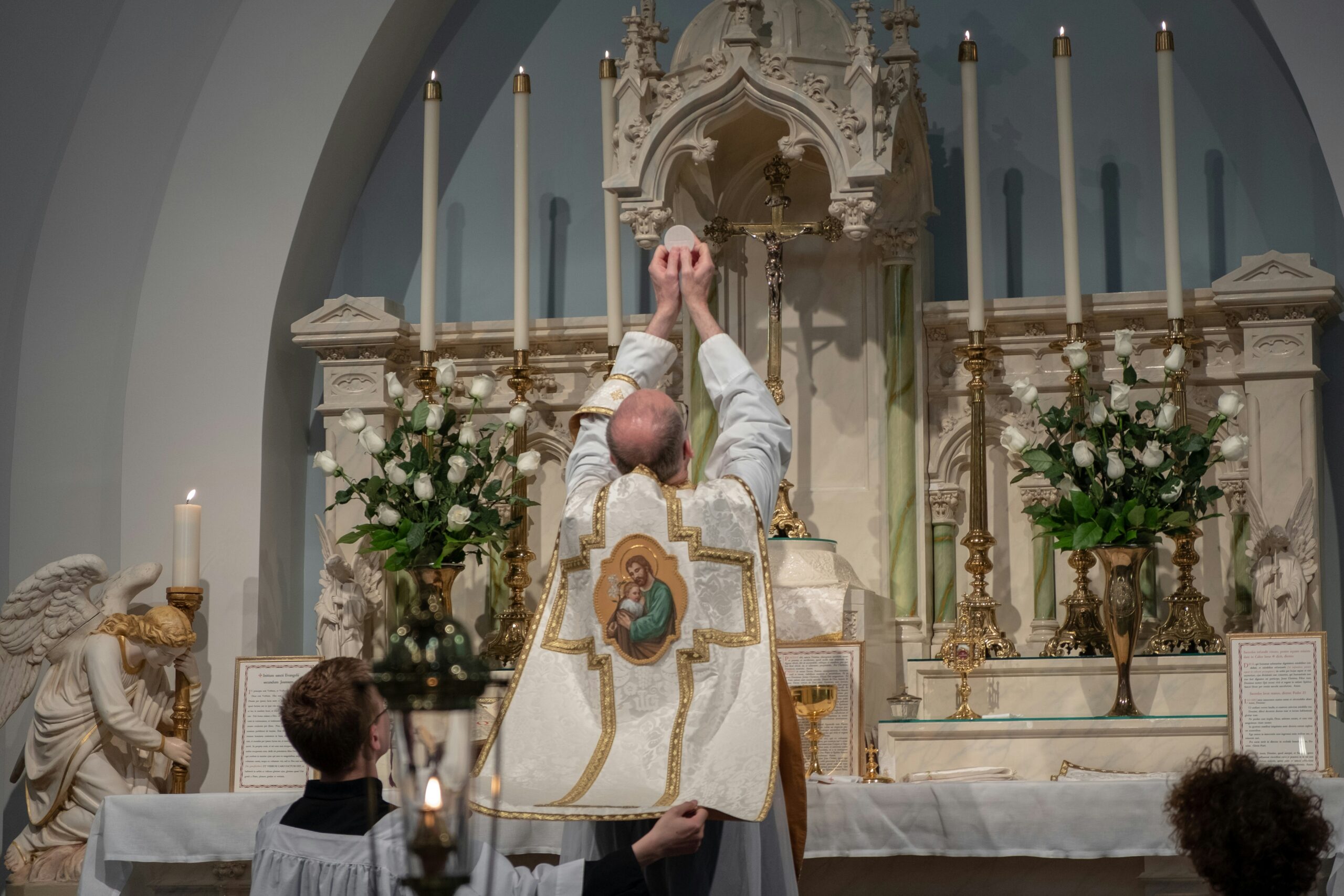
From the entrance hymn through Communion, everything is focused not on what God has done for us, but on Who He is. The focus is Him. We spend the whole Mass preparing our hearts for Him in a way that is quiet and awe-filled, because we really are about to witness the physical presence of a King whose glory we can’t even fathom—a King so powerful He can bring the dead back to life with a single word.
Then, after our hearts are filled with total reverence and awe at His glory, He comes to us in the humblest way.
He’s there, on the altar, and we say, “Lamb of God” three times, remembering that He is the One who takes away our sins and brings us peace. Then we tell Him that we’re not worthy to that He should come to us, but that one word from Him will heal our souls.
Now, my heart is ready. Carefully and silently, I go forward to receive His Body, Blood, Soul, and Divinity.
And I go back to my pew, but I don’t go alone.
Christ comes with me.
And He fills my heart with His. He listens to me—not just in the spiritual way He listens when we pray in our living rooms or cars, and not just because there are two or more people gathered in the room, but in the fullness of His Real Presence. He speaks to my heart—and it’s easy, because He is physically there, right inside it. He’s with me in a very real way—a way I never knew before I found the beauty of the Catholic faith.
I’m not the only one. At this point in the Mass, the church is filled with people on their knees, eyes closed, their faces entirely shielded from the world with their hands, blocking out anything that would interfere with their own heart-to-heart with Christ,
because He’s filling their hearts, too.
I’ve heard the point about “relationship” often, and I’ve experienced the “religion” in Catholicism, because that’s been my home for fourteen years now.
And I can tell you that all that time in the other worship rooms–it started me on the road Home to my Faith, and I’m thankful for it.
But never, never, anywhere, in any other church, across two states,
have I known the relationship with Christ that He’s given me through Catholicism…
Because every time I go to Mass, Jesus comes,
and He fills my heart with His own.
(Updated 2026 from 2016 version)
 P
P